
What Is Magnetic Particle Testing? A Complete Beginner’s Guide
Ensuring the safety and reliability of metal components is essential across industries such as construction, manufacturing, oil & gas, mining, aerospace, automotive, and power generation. Even the smallest surface crack can lead to equipment failure, costly downtime, or serious safety hazards if left undetected.
Magnetic Particle Testing (MPT/MPI/MT) is one of the most effective non-destructive testing (NDT) methods used to detect surface and near-surface defects in ferromagnetic materials. Since it doesn’t damage the component being inspected, it allows businesses to identify flaws while keeping equipment operational.
Whether you’re new to non-destructive testing or looking to understand how magnetic particle inspection works, this guide covers everything you need to know from the working principle and inspection process to advantages, limitations, applications, and frequently asked questions.
Table of Contents
- What Is Magnetic Particle Testing?
- How Does Magnetic Particle Testing Work?
- Principle Behind Magnetic Particle Inspection
- Step-by-Step Magnetic Particle Testing Process
- Equipment Used in Magnetic Particle Testing
- Types of Magnetic Particles
- Common Defects Detected
- Industries That Use Magnetic Particle Testing
- Advantages of Magnetic Particle Testing
- Magnetic Particle Testing vs Other NDT Methods
- Choosing a Professional Inspection Company
- Conclusion
- FAQs
- Contact Us
What Is Magnetic Particle Testing?
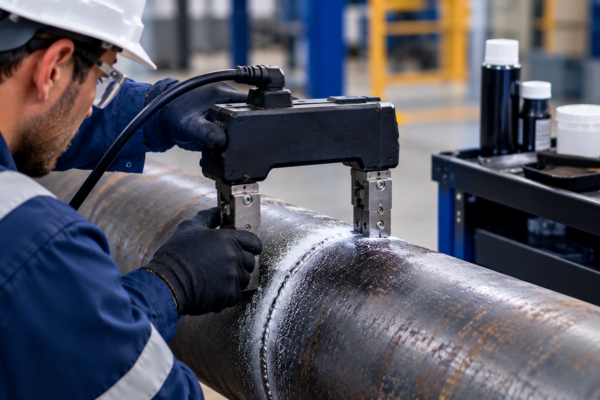
Magnetic Particle Testing (MPT), often called Magnetic Particle Inspection (MPI), is a non-destructive testing method used to detect cracks, seams, laps, inclusions, fatigue damage, and other discontinuities on or just beneath the surface of ferromagnetic materials.
The process works by magnetizing the test component. Fine magnetic particles are then applied over the surface. If a crack or defect exists, the magnetic field leaks around the discontinuity, attracting the particles and creating a visible indication.
Unlike destructive testing methods, MPT allows inspectors to evaluate the integrity of components without causing damage, making it ideal for routine inspections, preventive maintenance, and quality assurance.
How Does Magnetic Particle Testing Work?
The inspection process relies on magnetic field behavior.
When a steel component is magnetized, magnetic flux flows evenly through the material.
If the material contains a crack or discontinuity:
- The magnetic field leaks out at the defect.
- A leakage field is created.
- Magnetic particles gather around the leakage area.
- The accumulated particles form a visible indication showing the location and shape of the flaw.
This simple but highly effective principle makes magnetic particle testing one of the fastest methods for detecting surface defects.
Principle Behind Magnetic Particle Inspection
The inspection follows four basic principles:
Magnetization
A magnetic field is introduced into the component using specialized equipment.
Magnetic Flux Leakage
Any interruption in the material causes distortion of the magnetic field.
Particle Attraction
Magnetic particles are attracted to areas where the magnetic field escapes.
Visual Evaluation
Inspectors interpret the particle patterns to determine the size, orientation, and severity of defects.
Step-by-Step Magnetic Particle Testing Process
1. Surface Preparation
The component is cleaned to remove:
- Oil
- Dirt
- Rust
- Paint
- Scale
- Grease
A clean surface improves inspection accuracy.
2. Magnetization
The component is magnetized using suitable equipment based on its size and shape.
Common magnetization methods include:
- Yokes
- Prods
- Central conductors
- Coils
- Bench units
3. Application of Magnetic Particles
Particles are applied either:
- Dry powder
- Wet suspension
- Fluorescent particles
- Visible colored particles
4. Inspection
Inspectors examine particle indications under:
- White light
- UV light (for fluorescent inspections)
5. Demagnetization
After inspection, the part is demagnetized if required.
6. Cleaning & Reporting
Residual particles are removed, and a detailed inspection report is prepared.
Equipment Used in Magnetic Particle Testing
Professional inspections commonly use:
- AC Yokes
- DC Yokes
- Electromagnetic Yokes
- Permanent Magnets
- Wet Bench Systems
- Dry Powder Applicators
- UV Lamps
- White Light Sources
- Magnetic Particle Sprays
- Demagnetization Units
- Field Indicators
- Pie Gauges
Types of Magnetic Particles
Dry Magnetic Particles
Best suited for:
- Rough surfaces
- Large welds
- Field inspections
Wet Magnetic Particles
Suspended in oil or water for improved sensitivity.
Ideal for:
- Precision inspections
- Small defects
- Machine components
Fluorescent Particles
Viewed under ultraviolet light.
Offer:
- High sensitivity
- Excellent visibility
- Detection of extremely fine cracks
Visible Colored Particles
Used under normal lighting conditions.
Suitable for outdoor inspections and field work.
Common Defects Detected
Magnetic particle inspection can detect:
- Surface cracks
- Fatigue cracks
- Weld defects
- Grinding cracks
- Stress cracks
- Heat treatment cracks
- Seams
- Laps
- Cold shuts
- Lack of fusion
- Shrinkage cracks
- Quench cracks
Industries That Use Magnetic Particle Testing
Many industries depend on magnetic particle testing to maintain safety and product quality.
Common sectors include:
- Construction
- Structural steel fabrication
- Oil & Gas
- Manufacturing
- Mining
- Aerospace
- Automotive
- Marine
- Railways
- Pressure vessel manufacturing
- Pipelines
- Heavy equipment maintenance
- Wind energy
- Power generation
Businesses looking for reliable NDT Services in Canada often include magnetic particle inspection as part of their preventive maintenance and quality assurance programs.
Advantages of Magnetic Particle Testing
Some major benefits include:
Fast Inspection
Results are available immediately.
Cost-Effective
Requires relatively simple equipment.
High Sensitivity
Detects extremely small cracks.
Non-Destructive
Components remain usable after inspection.
Portable Equipment
Suitable for both workshop and field inspections.
Minimal Surface Preparation
Compared to several other inspection methods.
Reliable
Produces highly accurate results when performed by certified inspectors.
Magnetic Particle Testing vs Other NDT Methods
| Method | Detects Surface Cracks | Internal Defects | Material Restrictions |
Magnetic Particle Testing | Excellent | Limited | Ferromagnetic only |
Liquid Penetrant Testing | Excellent | No | Most non-porous materials |
Ultrasonic Testing | Moderate | Excellent | Most materials |
Radiographic Testing | Moderate | Excellent | Most materials |
Eddy Current Testing | Excellent | Limited | Conductive materials |
Choosing a Professional Inspection Company
Selecting the right inspection provider helps ensure accurate results and regulatory compliance.
Look for:
- Certified NDT technicians
- CSA W178.1 Certified company
- Industry experience
- Modern inspection equipment
- Detailed reporting
- Fast turnaround times
- Compliance with applicable standards
- On-site inspection capabilities
Companies offering MT Inspection Services Canada can help industries maintain equipment reliability through professional magnetic particle inspections.
For organizations operating in British Columbia, experienced providers offering Magnetic Particle Testing Surrey BC support inspections for structural steel, fabrication, industrial equipment, and welded components.
When safety-critical components require Surface Crack Detection BC, magnetic particle testing remains one of the most dependable inspection methods for identifying visible and near-surface discontinuities.
Conclusion
Magnetic Particle Testing is one of the most trusted non-destructive testing methods for identifying surface and near-surface defects in ferromagnetic materials. Its speed, accuracy, affordability, and ability to detect fine cracks make it an essential inspection technique across numerous industries.
Regular inspections help improve equipment reliability, extend service life, reduce unexpected failures, and support compliance with quality and safety standards. By incorporating magnetic particle testing into preventive maintenance programs, organizations can detect defects early and minimize costly repairs or operational downtime.
Contact Us
Contact us today to schedule your inspection, request a quote, or learn how our non-destructive testing solutions can support your quality assurance and maintenance programs.
Frequently Asked Questions
What materials can be inspected using Magnetic Particle Testing?
Only ferromagnetic materials such as carbon steel, cast iron, and certain alloy steels can be inspected.
Can Magnetic Particle Testing detect internal defects?
It is primarily designed to detect surface and near-surface defects. Deep internal flaws typically require ultrasonic or radiographic testing.
Is Magnetic Particle Testing destructive?
No. It is a non-destructive testing method that does not damage the component being inspected.
What types of defects can Magnetic Particle Testing identify?
It can detect fatigue cracks, weld defects, grinding cracks, seams, laps, quench cracks, and other surface discontinuities.
How long does a Magnetic Particle Inspection take?
Inspection time depends on the size and complexity of the component, but most inspections are completed quickly.
Is surface cleaning necessary before testing?
Yes. Proper cleaning ensures magnetic particles can accurately reveal defects.
Can painted components be inspected?
Thin coatings may still allow inspection, but thick paint layers can reduce sensitivity and may need to be removed.
Why is demagnetization performed after inspection?
Some components require demagnetization to prevent interference with future machining, welding, or service conditions.
Why is it important to choose a CSA W178.1 certified company for Magnetic Particle Inspection, Surrey, BC?
Choosing a CSA W178.1 certified company ensures that magnetic particle inspections are performed by qualified personnel under a certified quality management system, following recognized industry requirements for inspection, documentation, and quality control.