Introduction
Detecting cracks and surface defects before they become costly failures is essential in industries where safety, quality, and reliability are top priorities. Even the smallest flaw in a metal, plastic, or ceramic component can compromise structural integrity, reduce product lifespan, and lead to unexpected equipment failures.
Liquid Penetrant Testing (LPT), also known as Dye Penetrant Inspection (DPI), is one of the most widely used non-destructive testing (NDT) methods for identifying surface-breaking defects. It is a simple, cost-effective, and highly sensitive inspection technique that can detect fine cracks invisible to the naked eye.
Unlike destructive testing methods, Liquid Penetrant Testing allows inspectors to examine components without causing any damage, making it an ideal solution for quality control, preventive maintenance, manufacturing, fabrication, and safety inspections.
This beginner-friendly guide explains what Liquid Penetrant Testing is, how it works, its advantages, limitations, applications, inspection process, and why it remains one of the most trusted non-destructive testing methods across various industries.
Table of Contents
- What Is Liquid Penetrant Testing?
- How Does Liquid Penetrant Testing Work?
- Principle of Liquid Penetrant Testing
- Step-by-Step Liquid Penetrant Testing Process
- Types of Liquid Penetrants
- Types of Developers
- Equipment Used in Liquid Penetrant Testing
- Materials Suitable for Testing
- Common Defects Detected
- Industries That Use Liquid Penetrant Testing
- Advantages of Liquid Penetrant Testing
- Liquid Penetrant Testing vs Other NDT Methods
- Inspection Standards and Codes
- Choosing the Right Inspection Provider
- Conclusion
- Frequently Asked Questions
- Contact Us
What Is Liquid Penetrant Testing?
Liquid Penetrant Testing (LPT) is a non-destructive testing method used to detect surface-breaking defects in both metallic and non-metallic materials. The process involves applying a specially formulated liquid penetrant to a clean surface. The penetrant seeps into tiny cracks, pores, and other discontinuities through capillary action.
After allowing sufficient penetration time, the excess penetrant is removed, and a developer is applied. The developer draws the penetrant back to the surface, creating visible indications of any defects.
Because LPT only detects flaws that are open to the surface, it is especially effective for identifying fine cracks, pinholes, porosity, laps, seams, and leaks that may not be visible during a visual inspection.
How Does Liquid Penetrant Testing Work?
The inspection process is based on a simple but effective principle called capillary action.
When a low-viscosity penetrant is applied to a clean component, it naturally flows into any surface-opening defects. Once the excess penetrant is removed, the trapped liquid remains inside the flaws.
Applying a developer creates a contrasting background and draws the penetrant back to the surface, making defects clearly visible for inspection.
Depending on the inspection method, indications may be viewed under normal white light or ultraviolet (UV) light using fluorescent penetrants.
Principle of Liquid Penetrant Testing
Liquid Penetrant Testing relies on three scientific principles:
Capillary Action
The penetrant naturally flows into extremely small openings due to surface tension.
Penetration
The liquid fills cracks and discontinuities that are open to the surface.
Developer Action
The developer extracts trapped penetrant from defects, producing visible indications that inspectors can evaluate.
This simple process provides highly accurate detection of very small surface flaws without damaging the component.
Step-by-Step Liquid Penetrant Testing Process
1. Surface Preparation
Proper cleaning is the most critical step in Liquid Penetrant Testing.
The surface must be free from:
- Oil
- Grease
- Dirt
- Rust
- Paint
- Welding slag
- Scale
- Moisture
A clean surface allows the penetrant to enter defects without obstruction.
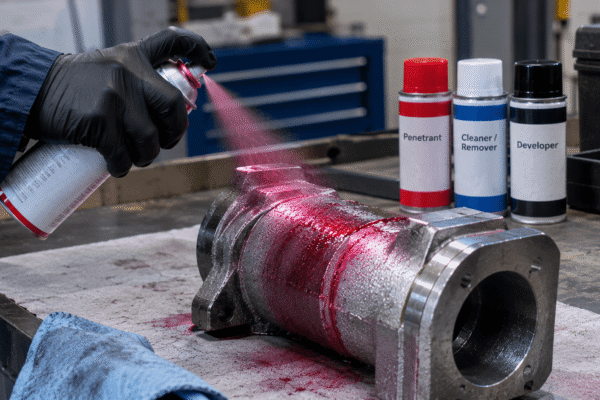
2. Penetrant Application
A visible or fluorescent penetrant is evenly applied using:
- Spray
- Brush
- Immersion
- Flow-on methods
The penetrant is allowed to dwell on the surface for a specified time so it can enter any defects.
3. Excess Penetrant Removal
After the dwell time, excess penetrant is carefully removed without extracting penetrant trapped inside discontinuities.
Removal methods vary depending on the penetrant type and may involve water rinsing, solvent cleaning, or emulsification.
4. Developer Application
A developer is applied to the surface to draw penetrant out of the defects.
The developer also creates a uniform background that improves contrast and makes indications easier to identify.
5. Inspection
Certified inspectors examine the component under appropriate lighting conditions.
Inspection methods include:
- Visible dye inspection using white light
- Fluorescent inspection using UV-A light in a darkened environment
The size, shape, and location of indications help determine the nature of the defect.
6. Post-Cleaning
After inspection, the developer and remaining penetrant are removed from the component if required.
7. Documentation
Inspection results are recorded in a detailed report that includes:
- Inspection method
- Materials tested
- Defect locations
- Acceptance criteria
- Final evaluation
Types of Liquid Penetrants
Visible Dye Penetrants
Visible dye penetrants produce red indications under white light and are commonly used for general industrial inspections.
Benefits
- Easy to use
- Cost-effective
- No UV lighting required
Fluorescent Penetrants
Fluorescent penetrants glow brightly under ultraviolet light.
Benefits
- Higher sensitivity
- Better defect visibility
- Ideal for detecting extremely fine cracks
Types of Developers
Several developer types are used depending on inspection requirements.
Dry Powder Developer
Suitable for fluorescent penetrants and provides excellent sensitivity.
Water-Soluble Developer
Dissolves completely in water and produces uniform coverage.
Water-Suspendable Developer
Provides consistent coating while remaining suspended in water.
Non-Aqueous Wet Developer
Applied using spray cans and commonly used with solvent-removable penetrants.
Equipment Used in Liquid Penetrant Testing
Professional inspections typically use:
- Cleaner or remover
- Visible dye penetrant
- Fluorescent penetrant
- Developer
- UV-A inspection lamps
- White light sources
- Spray applicators
- Cleaning cloths
- Inspection booths
- Surface preparation tools
- Timing devices
- Magnifying lenses
Materials Suitable for Liquid Penetrant Testing
One major advantage of Liquid Penetrant Testing is its ability to inspect many different materials.
Suitable materials include:
- Carbon steel
- Stainless steel
- Aluminum
- Brass
- Copper
- Titanium
- Magnesium
- Ceramics
- Plastics
- Glass
The material must have a clean, non-porous surface for accurate inspection.
Common Defects Detected
Liquid Penetrant Testing can identify many surface-breaking defects, including:
- Fatigue cracks
- Grinding cracks
- Heat treatment cracks
- Welding cracks
- Porosity
- Pinholes
- Seams
- Laps
- Cold shuts
- Leaks
- Lack of fusion
- Surface tears
Industries That Use Liquid Penetrant Testing
LPT is widely used across industries where component integrity is critical.
Common applications include:
- Aerospace
- Automotive
- Oil and Gas
- Manufacturing
- Structural Steel Fabrication
- Mining
- Marine
- Railways
- Pressure Vessel Fabrication
- Nuclear Industry
- Power Generation
- Petrochemical Plants
- Heavy Equipment Maintenance
Organizations seeking NDT Services in Canada often rely on Liquid Penetrant Testing as part of their quality assurance and preventive maintenance programs.
Advantages of Liquid Penetrant Testing
Liquid Penetrant Testing offers several important benefits.
- Non-destructive inspection
- Detects extremely fine surface defects
- Suitable for many materials
- Simple inspection process
- Cost-effective
- Portable equipment
- Fast inspection results
- Minimal operator training for basic applications
- High sensitivity
- Suitable for complex component shapes
Liquid Penetrant Testing vs Other NDT Methods
Inspection Method | Surface Defects | Internal Defects | Suitable Materials |
Liquid Penetrant Testing | Excellent | No | Most non-porous materials |
Magnetic Particle Testing | Excellent | Limited | Ferromagnetic materials |
Ultrasonic Testing | Moderate | Excellent | Most materials |
Radiographic Testing | Moderate | Excellent | Most materials |
Visual Inspection | Limited | No | All materials |
Inspection Standards and Codes
Professional Liquid Penetrant Testing is commonly performed in accordance with recognized industry standards, including:
- ASTM E1417
- ASTM E165
- ASME Boiler and Pressure Vessel Code
- ISO 3452
- AWS welding inspection standards
Following these standards ensures consistent inspection quality, accurate reporting, and compliance with customer and regulatory requirements.
Choosing the Right Inspection Provider
Selecting an experienced inspection provider helps ensure accurate results and dependable quality assurance.
Look for a company that offers:
- Certified NDT inspectors
- Modern inspection equipment
- Compliance with international standards
- Detailed inspection reports
- Fast turnaround times
- On-site inspection services
- Industry-specific experience
Companies providing Liquid Penetrant Testing Surrey BC support industries such as manufacturing, construction, fabrication, and energy by delivering reliable inspections for critical components.
Businesses requiring Dye Penetrant Inspection Canada can benefit from certified technicians who follow recognized inspection procedures and quality standards.
For organizations focused on Surface Flaw Detection Services BC, Liquid Penetrant Testing offers an effective solution for detecting fine surface defects before they lead to costly failures or downtime.
Conclusion
Liquid Penetrant Testing is one of the most effective and economical non-destructive testing methods for identifying surface-breaking defects in a wide range of materials. Its simplicity, versatility, and ability to detect even microscopic cracks make it an essential inspection technique across numerous industries.
Whether used during manufacturing, fabrication, maintenance, or quality assurance, LPT helps improve product reliability, enhance workplace safety, reduce maintenance costs, and prevent unexpected equipment failures. By incorporating regular inspections into maintenance programs, organizations can identify defects early, extend component life, and maintain compliance with industry standards.
Contact Us
Need Professional Liquid Penetrant Testing Services?
Contact us today to schedule your inspection, request a quote, or learn how our non-destructive testing solutions can help protect your equipment, improve quality assurance, and reduce costly failures.
Frequently Asked Questions
What is Liquid Penetrant Testing used for?
It is used to detect surface-breaking cracks, porosity, seams, laps, and other discontinuities in non-porous materials.
Can Liquid Penetrant Testing detect internal defects?
No. It only identifies defects that are open to the surface.
Which materials can be inspected?
Steel, stainless steel, aluminum, titanium, copper, brass, ceramics, plastics, and glass can all be inspected if they have non-porous surfaces.
Is Liquid Penetrant Testing destructive?
No. It is a completely non-destructive inspection method.
Why is surface cleaning important?
Cleaning removes contaminants that could prevent the penetrant from entering defects, ensuring accurate inspection results.
What is the difference between visible and fluorescent penetrants?
Visible penetrants are inspected under white light, while fluorescent penetrants require UV-A light and provide higher sensitivity.
How accurate is Liquid Penetrant Testing?
When performed by qualified technicians following industry standards, Liquid Penetrant Testing (LPT) is highly effective at detecting very small surface defects.
Which industries benefit most from Liquid Penetrant Testing?
Industries such as aerospace, automotive, manufacturing, oil and gas, marine, mining, power generation, and structural fabrication commonly use this inspection method.